
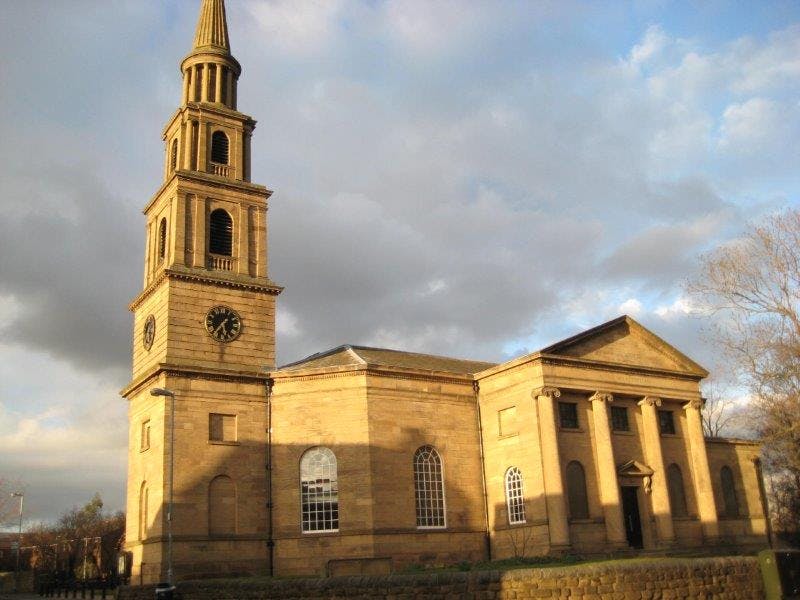
The Church of St. Peter and St. Leonard is a Grade I listed building standing in the conservation area of the oldest part of the township of Horbury. It was built by the architect John Carr on the site of a Norman church dedicated to St. Leonard. About 1788/89, John Carr, who started life as a Horbury stonemason offered to rebuild the old church that had stood in Horbury since the 12th century. The last sermon was preached on January 24th 1790 and work on demolition began on the 28th of the same month. Carr donated a sum of £8,000, with a further £2,000 for the bells and organ, which he added later as a gift to the town of his birth.
In July 1950, repairs were taking place at St. Peter’s church and under the floor of the vestry, a flight of stone steps was discovered, leading to a low wooden door. When this door was opened, a vault was discovered in which lay the previously undiscovered coffin of John Carr.
On the night of December 11th 1883, a violent storm struck Horbury. Five feet or more of the church spire of St Peter’s came falling down in the high winds. The falling stone went through the church roof and then through the gallery floor, breaking several flagstones and fracturing hot water pipes below.
Originally, the church clock at St. Peter’s had only one south-facing dial pointing towards the centre of the village. In 1899, Benjamin Wilson (1856 – 1930), a cloth manufacturer of “Inwood”, Benton Hill, Horbury donated two additional cast iron clock faces. These were placed on the north and west sides of the church spire, giving people a sight of the church clock from most parts of Horbury. Originally the church had only six bells, Wilson kindly donated another two church bells, making eight in total. This then allowed for a shorter quarter chime to chime at quarter past the hour, half past the hour and quarter to the hour.
The bells and supporting wooden headgear in the church tower at St. Peter’s Church were replaced in 2019.
Graves
Towards the north entrance of the church, which is open to the public 6 days per week, lie two medieval cross slab tomb covers, which have recently undergone conservation. These cross slabs date from the early 14th century and are the last remaining fragments of the medieval church that existed on the present site. It is believed they belonged to the Amyas family, and that their important led to their retention when Carr built the present building in the 1790s, though the slabs were moved at this point from the south side of the church to their present location. Both are tapered and feature high reliefs: a cross with fleur-de-lys terminals and smaller diagonal fleur-de-lys between the arms on one; and a cross with clustered fleur-de-lys springing from the shaft on the other. They are listed separately to the church and are also Grade I listed.